2016 Guerrilla Gravity Downhill (GG/DH) Review
 Tuesday, February 2, 2016 at 5:11PM Permalink
 ;)
Guerrilla Gravity is a small mountain bike company located in Denver Colorado. They were sick of frame prices shooting through the roof while production moved overseas with little, if any, performance increase from year to year. All this while many bike companies grew in size and became more distant from their customers and what they really wanted in geometry and suspension designs. Who wants to buy a frame for $3500 and have part of it go to subsidize some road racers salary anyhow?
We tested their Megatrail last year and it proved to be an insane trail rig. Not only was it insane descending, but when using Trail mode it was one of the best climbing enduro bikes we have ever ridden. The guys at Guerrilla Gravity emailed and asked if we would be interested in testing out their updated 2016 GG/DH frame? Hell yes we would!
;) Andrew Soto Shredding The GG/DH
Andrew Soto Shredding The GG/DH
Upon receiving the GG/DH we opened up the box and found a clean looking frame with great welding and paint to match. Guerrilla Gravity had four updates that it did wit the 2016 GG/DH frame. The first was to remove the shock mount eccentrics for BB height/HA adjust and replaced it by adding two holes for Park Mode and Race Mode geometry adjustments. Just like the Megatrail uses. They also increased tire clearance and optimized the frame for 650b wheels. The last update was to the rear axle and was aimed to improve it's function.
2016 GGDH Build Kits
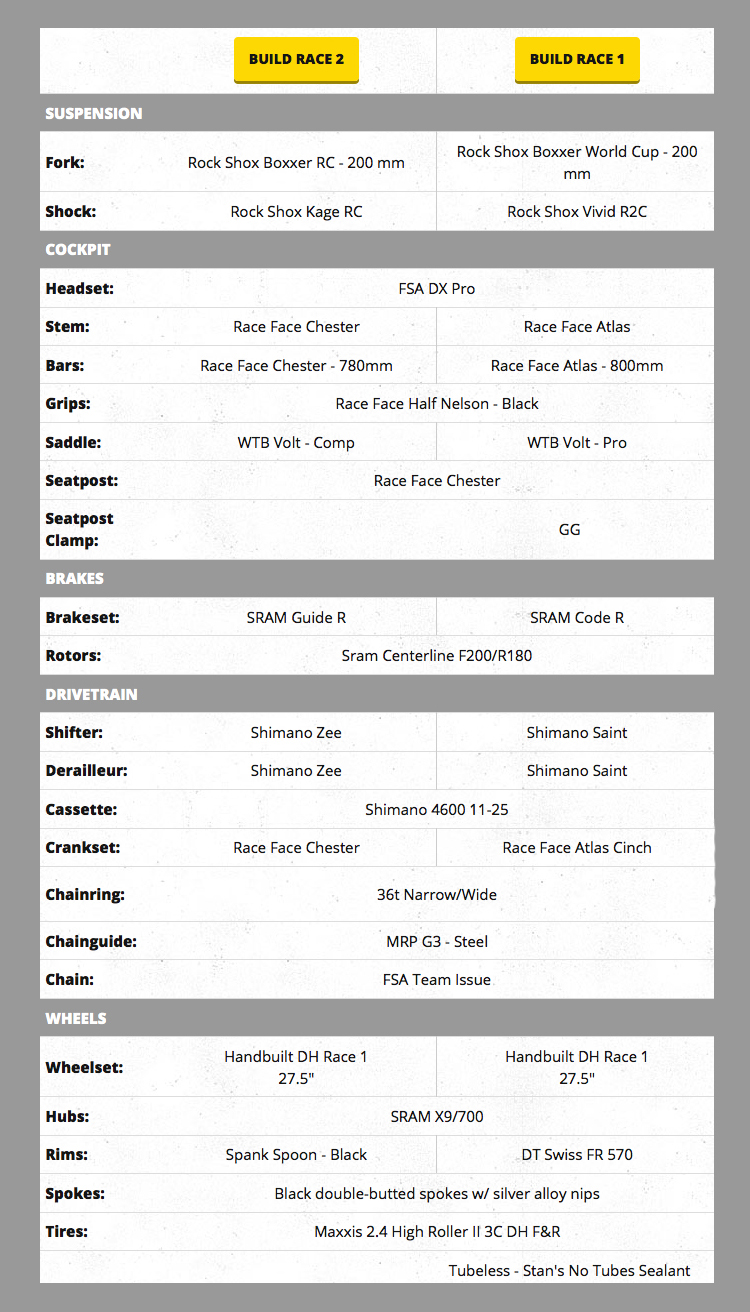
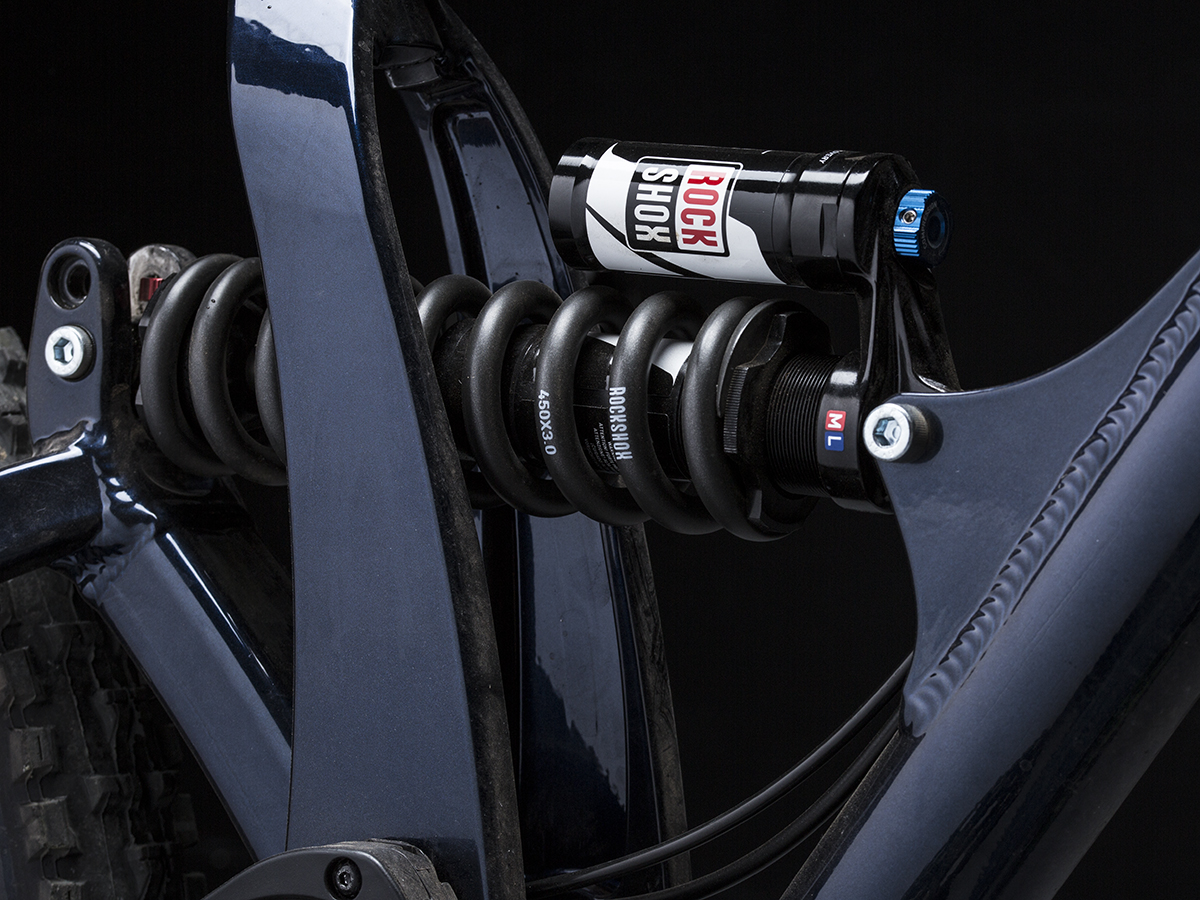
The guys at GG sent us the bike with a blend of the two kits. It had the Boxxer WC, Atlas controls, Zee shifting and the nicer wheels. It had the Kage RC shock on it as well. Our medium GG/DH with Hope flat pedals came in at 37.5 LBS. Overall the build kit is decent the one thing we would swap out is probably the rear shock. It would be nice to have separate HSC and LSC adjustments to fine tune the bikes ride with. After riding trail bikes for so long with air shocks it is a surprise to see how much traction this bike gives even on the steepest and loosest of trails. Maybe there really is something to coil shocks......
I am 6' 1" tall and the MD fit me okay. I think I would buy the LG as a personal bike and run a shorter stem possibly. I am right between sizes so that always makes it tricky. Andrew is 5' 9" and said it felt great. Having a TT of 24.6" on a MD makes it close to 1" longer than many companies MD offerings and it is the same size as the large Specialized Demo.
"The GG/DH is a refined machine built for riders that like goin' fast.
With a suspension platform that is progressive and a frame that is laterally stiff, the GG/DH is designed to carry speed and pop off bonus lines at will. The enclosed rear triangle provides snappy cornering and rails lines better than John Belushi.
The frame design eliminates all unnecessary complication, creating the bike for those that like to get out and ride day in and day out, for riders that want something that's high performance, yet easy to maintain. By eliminating the need for additional pivot hardware, you are left with one pivot that utilizes long-lasting Enduro bearings. Limit your time inside doing maintenance and go ride.
The ride characteristics provide a lively, nimble platform that pedals extremely well for its downhill capabilities. The geometry is low, slack, and adjustable. Choose between Park Mode and Race Mode via the rear shock mount adjustment that are easy and quick to change."
;)
;)
Forward Geometry Benefits
- Security in steep areas
The front axle is more advanced than in a conventional geometry making it almost impossible to go over the bars in steep sections. It feels more secure and confident due to a slacker angle perception.
- Confidence at high speed
The longer wheelbase makes the bike much more stable over any terrain.
- Direct steering
The really short 10 mm, 30 mm or 50 mm stems mean much less handlebar movement to get the same front wheel angle, thus improving steering precision and making the bike extremely reactive.
- Uphill precision
The front wheel keeps the contact on the ground avoiding wheelies due the longer front-center length.
- Stability on rough sections
The FG defends a new weight balance between front and rear wheels making possible to load the front wheel a lot more than with a classic geometry. This possibility changes your handling as it allows for more grip in cornering and better control.
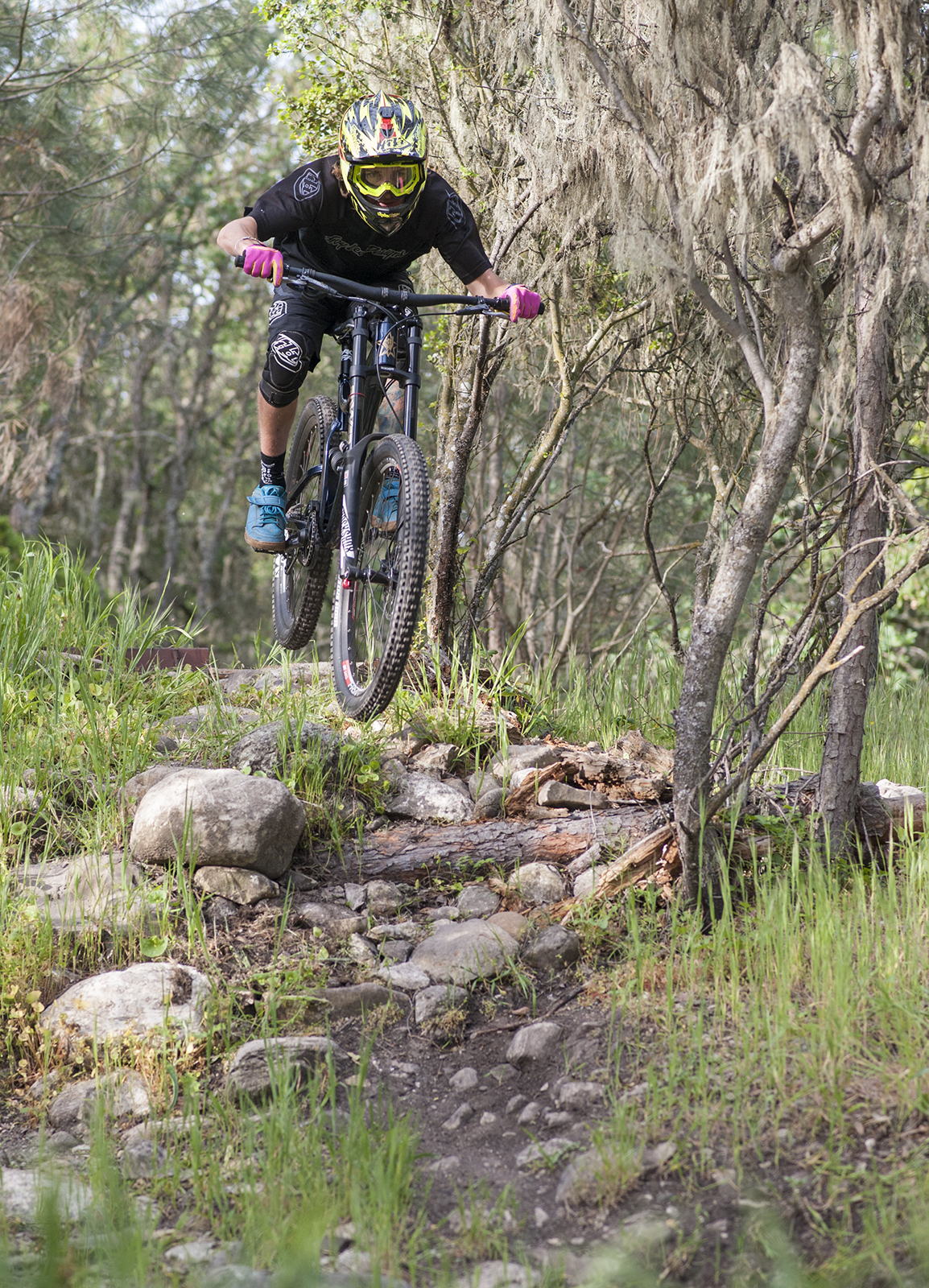 Andrew Soto Shredding The GG/DH
GGDH Features
- 203 mm (8") rear travel
- Dual modes adjusted via shock mount
- Race Mode
- Park Mode
- Threaded bottom bracket, greatly reduces creaking and loosening (vs press fit)
- Massive 25mm pivot axle
- Zero Free Play pivot and axle interfaces
- Premium Enduro dual-lip sealed cartridge bearings
- 7.9 lbs. (3,583g) frame with hardware (size Medium, no shock)
GGDH Specs
- 30.9 mm seatpost (34.9 mm clamp)
- 1.5" head tube (49 SHIS - compatible with all steerer tubes and the Cane Creek Angleset)
- ISCG05 chainguide mount
- 148 mm rear wheel spacing
- 83 mm bottom bracket spacing
- 240x76 mm shock
- Max tire size: 27.5 x 2.5
GGDH Geometry
;)
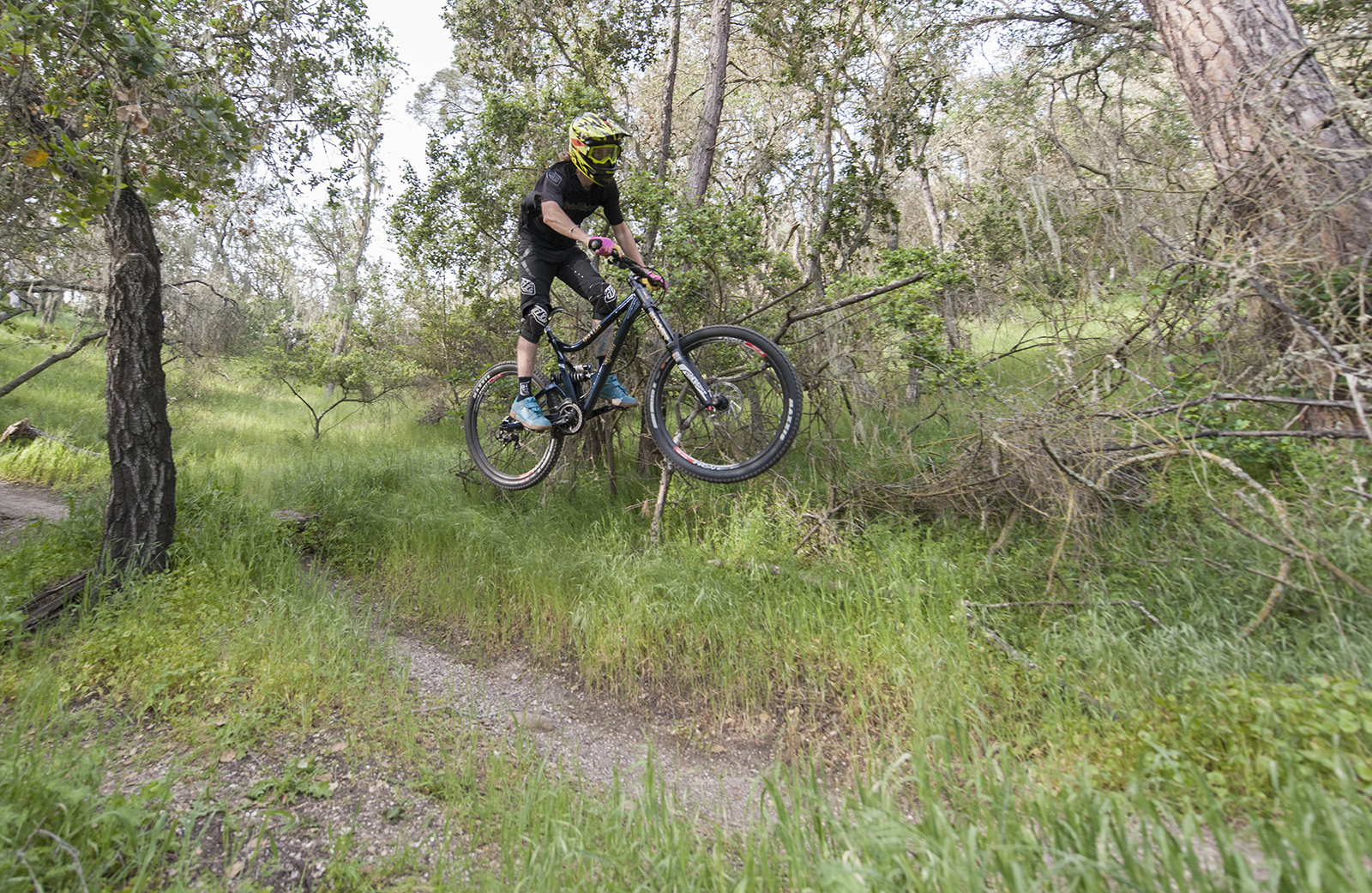
Similiar to the Megatrail the GG/DH offers two travel/geo options. One is Park and the other is Race. While riding the Mega we noticed a huge difference in the two settings and we where wondering if the same would hold true for their downhill bike.
 Andrew Soto Shredding The GG/DH
GGDH Owner Information
Proper suspension set-up is critical for optimum performance. Due to variance in shock pump readings, we suggest using a ruler and a friend to help set sag.
Recommended front fork sag is 15%. Recommended shock sag is 18-20 mm.
To set sag:
- Step 1: Compress the suspension several times to break the seal and get oil flowing
- Step 2: Have a friend hold the bike while you stand in the attack position, both feet on the pedals
- Step 3: Have said friend take the eye-to-eye measurement of the rear shock in millimeters. Subtract this number from 76 mm. You now have your sag
- Step 4: If you're using an air shock adjust the air pressure using your shock pump to achieve the recommended sag setting (listed above). It may take a few times.
Shock specific setup info:
- Cane Creek DBcoil: Cane Creek shocks purchased with a frame come preset with the base tune--you just need to set sag and tweak the damping settings to your weight, with gear weight taken into account. The base tune is dialed in for a rider weight of 175 lbs. Adjust +/- 2 clicks of low speed settings and 1/4 turn of high speed settings for every 20 lb increment of rider weight difference from 175 lbs. Email us to talk further about shock settings for your unique riding style and terrain.
- Cane Creek DBair: Cane Creek shocks purchased with a frame come preset with the base tune--you just need to set sag and tweak the damping settings to your weight, with gear weight taken into account. The base tune is dialed in for a rider weight of 175 lbs. Adjust +/- 2 clicks of low speed settings and 1/4 turn of high speed settings for every 20 lb increment of rider weight difference from 175 lbs. Email us to talk further about shock settings for your unique riding style and terrain.
 Andrew Soto Shredding The GG/DH
Ian W
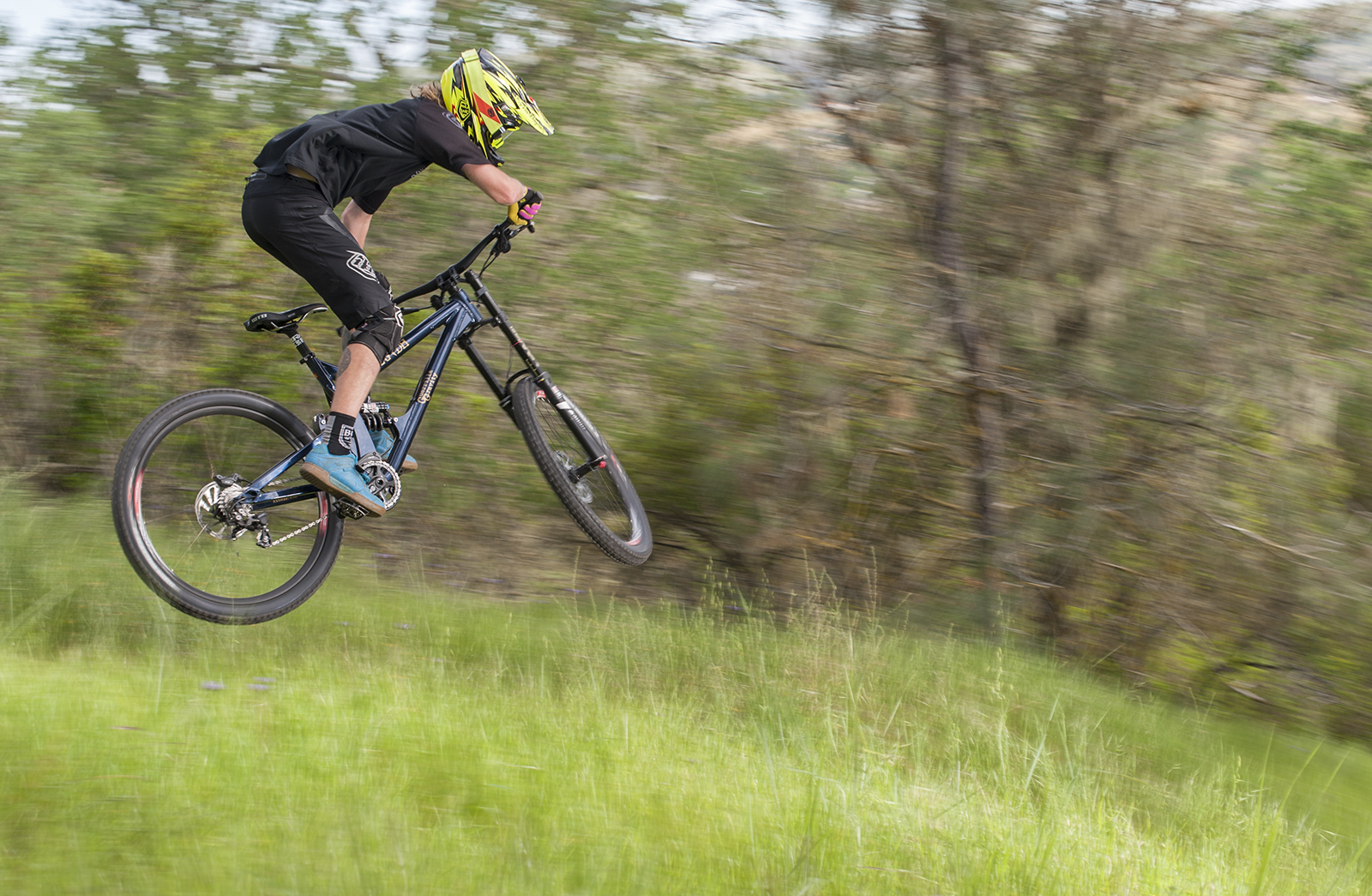
The first trail I took the GG/DH out on was one that I have not ridden in almost three years! This trail is steep, rocky, loose and nasty. It drops 1350 feet in 3/4 of a mile. It is littered with sharp embedded rocks and has a heavy layer of loose shale in sections. There are very tight turns in some sections and a few high speed steeps that have some soil. Overall it is a great trail to test a bikes GEO and suspension out on. I was in a bit over my head trying to ride this trail after so long. You drop into the trail and it enters a high speed section that is littered with good size rocks. The GG/DH did a good job at absorbing the harsh high speed impacts. There is a small uphill then the trail turns downhill in a very steep fashion for about 100 yards. This section was covered in loose shale and hard embedded rock. I went in slow and used front and back brakes. What shocked me most was the traction! Holy hell the rear tire just kept gripping the whole way down. Overall the bike felt great on the steep chunky terrain it reminded me of the Bruce Lee quote “Be like water making its way through cracks. Do not be assertive, but adjust to the object, and you shall find a way around or through it." Riding down this chunky trail I was reminded how easy it is to adjust most single pivot bikes. Everything felt good from small bump, bottom out and the GG/DH offered stability in spades.
San Luis Obispo offers rocks and lots of them. There is a trail in town that is 1000 feet and has baby head boulder most of the way down the trail. It isn't very steep so a burly trail bike has some overall speed advantage but riding a DH bike on it reminds you how much better they are at eating up rough terrain compared to Enduro bikes. Riding behind a 150mm bike while on a big bike you can watch the rider moving around to help absorb the trail while you sit back and move only if needed. Again I noticed the rear offering good traction when needed. I was actually suprised by The Boxxer WC it felt very good. Super supple and offered decent mid stroke support. Matt at GG said the leverage curve is what gave the bike such confidence inspiring grip. Another thing of note was how easy it was to change lines with the bike. I could hop it over and off rocks easily even in Race Mode.
The bike was very playful in both modes. Using it in Park Mode it is a bit more poppy and easy to move around but it is not as huge of a job as we noticed while testing The Megatrail last year. I am not sure I would run it in that setting a whole bunch unless the terrain you where riding was loaded with jumps the whole way down.
;)
Conclusion
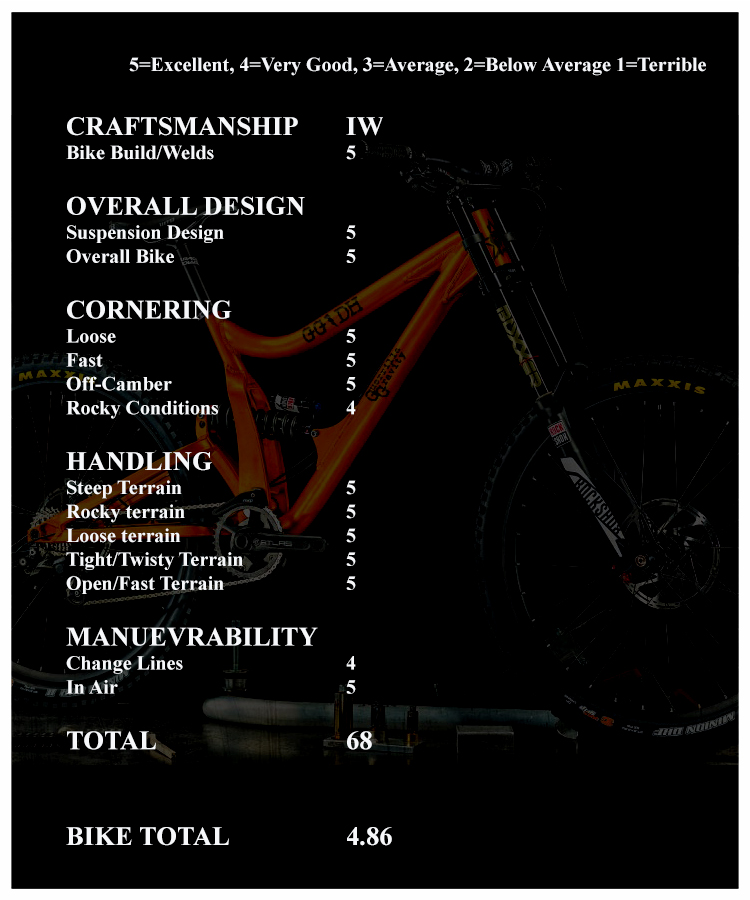
After ridng the Megatrail and being so impressed with it we really where not surprised to find the Guerrilla Gravity downhill bike to be so dialed. The geometry isn't super aggressive either with BB height or head angle but the frame is long. I was a bit nervous getting the medium frame but it turns out their sizing recommendations for the GG/DH are pretty spot on. We have had a YT Tues for almost 8 months now and it is a size large. The GG/DH in a size MD feels the same or maybe a tad longer in the reach department and on paper it is.
Overall we where very impressed with the GG/DH. It's strong point would be it's forward geometry and stiff frame. Point the bike along boulder edges and it will try its hardest to hold onto them. Come into a corner to hot and have to break the rear end loose to make the turn no problem. Guerrilla Gravity did a good job building a stiff chassis by using a huge 25mm pivot axle and oversized tubing. We noted how stiff the Megatrail chassis was and I would say the GG/DH is one of the stiffer DH frames we have ridden.
Traction is something this bike offers by the truckload. I was blown away going down the steep shale trail with brakes on hard that it was sliding all over the hill. This is somewhat due to its coil spring but also its very supple suspension curve. A nice thing about Single Pivot bikes and their suspension curve is how easy they are to set up. Typically we run a bit more LSC with them and since they are somewhat linear feeling we can add more HSC or bands into an air shock to resist bottoming while still keeping a bunch of traction. The frame we tested was a MD GG/DH and it fit me well. I am six foot one inch and I could probably ride the LG as well with a shorter stem on it. Again the GG MD is the same size as The Specialized Demo.
It is for sure a bike we would reccomend to a friend and it being made here in the sates is a nice added touch that is getting harder to find by the year.
Guerrilla Gravity Downhill Questions
3. Break down your team for us and what they do?
4. How did the idea for the GG/DH begin?
5. What where some of the main features you guys wanted in the GG/DH when you were laying it out on paper (computer)?
- Geometry built for speed
- Predictable suspension performance with high traction and support
- Stiff & strong frame
- Versatility for a more poppy Park setup or a more plowy Race setup
6. How was reception been on the GG/DH so far?
7. Do you weep when you see guys that are 6' 4” and above on a “XL” bike and they look like Spud Webb on a 16” BMX bike?
8. Are you going to be doing an XL frame soon?
9. Any updates you guys are looking to do to the GGDH in the near future?
10. Care to elaborate on Geometry used on the GG/DH?
11. Rocks or jumps? How about jumps in rocks?
12. Who is the best Mountain Biker ever?
13. What do you think about all the new standards that have popped up in the last 3 years?
14. What would make the bike industry better?
15. Anything else you want to get across to the readers?
Guerrilla Gravity DH Owner's Manual
Magura MT7 Next Disc Brake Review
Saturday, October 11, 2014 at 3:05PM Permalink
;)
;)
;)
;)
Magura has been in the brake business for over two decades. Back in the day when people where pumped on V-Brake performance the people at Magura were selling Hydraulic Rim Brakes for mountain biking. These brakes are still very popular on trials bikes. Many World Cup riders ran these brakes back in the day. Magura has relaunched their MT line and introduced a gravity/enduro specific brake called the MT7 Next is is a dual piston design with four pads. We reviewed the MT8 when they first came out a few years ago. The brakes worked well even in the downhill capacity we tested them in. Considering this was a featherweight AM/XC brake that speaks well for Magura and its brakes as a whole. We are very excited to test a gravity specific brake from them in the form of the Magura MT7 Next Disc Brake!
These brakes are a very light DH brake option. Using the Carbotecture lever housing helps keep the weight low. We have used brakes that weigh easily 200 grams more per brake in the past. So being able to save almost a pound in the brakes alone is a nice bonus. We opted for the MT7 with toolless adjustment. Magura informed us we would have less adjustment with these than the tool versions offer but more on that later.
We used 203mm SL rotors front and rear on a large megatrail. The bike was built up with heavier parts for the more gravity based riding it would be put through.
"The MT7 stands for maximum braking performance and stability in extreme conditions. In the tough, bike-testing worlds of Enduro and Downhill, the additional braking power of the 4 brake pistons is a positive safety factor. The aluminium, two-finger brake lever - with toolless adjustment - and the adjustable bite point provide the necessary ergonomics for perfect brake control, even in difficult terrain and on long downhill runs. 5-year leakproof guarantuee for brake levers and cylinders after providing the original proof of purchase."
Features
- Actual weight: 271 grams
- Four-piston caliper
- 17mm pistons
- Mineral oil
- Tool-free reach and pad contact adjustment
- Carbotecture SL composite lever housing
- Does not include rotor or adapter
- One-year warranty
- Made in Germany
Technology
| Weight | ~375 g (including 160 mm Storm Rotor) |
| Colour | Black-Fluro-Yellow (Master), Mystic Grey Anodized (Caliper) |
| Technical features | Full hydraulic dual piston floating caliper |
| Hydraulic system | Open, with expansion chamber |
| Intern. standard mounting (IS) | Yes, adaptor |
| Pad wear adjustment | Automatic |
| Postmount mounting (PM) only front | Yes, direct mount |
| Disc diameter (mm) | Front 203, 180, 160 Rear 203, 180, 160 |
| Centerlock compatible | Yes, with adaptor |
| Transmission medium | MAGURA Royal Blood mineral oil |
| Brake hose | MAGURA disc tube easily shortened |
| Hose fitting caliper | RHR - Rotateable hose routing |
| Brake pads | Organic 9.1 Performance (4 Pistons 2 Pads) 8.1 Performance (4 Pistons 4 Single Pads) |
| Material fitting bolts | Aluminium |
| Brake lever and caliper | Carbotecture SL (Master), Aluminium forged (caliper) |
| Lever blade | Aluminium |
| Reach adjust | Yes (tolless) |
| OPD (caliper in one-piece design) | Yes |
| BAT (bite point adjuster) | Yes (tolless) |
| EBT (Easy Bleed Technology) | Yes |
| 2-Piece Lever Clamp | Yes |
| Dual Docking for trigger shifters | No |
| magnetiXchange | Yes |
| Feel-Safety-Ergonomic | Yes |
Cabotecture Explained
"The MAGURA Research Team has been analyzing rigidity and strength test results during it’s MISSION PERFORMANCE, that different types of conventional materials like die cast aluminium, magnesium or laminated carbon fibres show a variety of important material deficiencies. Our material competence confirms these results.
The ideal material to build the best brake in the world would be extremely tensile, ductile and have an immense ability to bend. It would endure a lifetime of heavy use, would be absolutely precise, dimensionally stable and fatigue durable over many years. These materials exist – but they are generally too heavy or very difficult to process (titanium) and are therefore unsuitable for bicycle use.
Special lightweight and extremely strong carbon fibre materials have been introduced recently quite successfully in many high-tech areas such as automotive or aeronautics. MAGURA is the only bike component manufacturer experienced in manufacturing those materials for the industry and thus has the core competence in house. The MISSION PERFORMANCE follows this track and develops together with the best renowned manufacturers a brand new material: Carbotecture®.
The exact composition of this material remains a closely guarded secret – but we can reveal the following: Carbotecture® is the perfect material for the new exclusive Carboflow® process, also developed by MAGURA. Carbotecture® consists of a high percentage of carbon fibres in a thermoplastic matrix. This new material can not be compared with any known fibre reinforced plastic or laminated carbon fibre mats.
Properties of the material
- Extremely light (less than half the density of aluminium).
- Tensile strength in between aluminium and steel, extremely impact resistant and break proof ...
- Highest flexural fatigue strength of all conventional bike component materials.
- The efficiency weight (tensile strength/density) is double that of aluminium or magnesium and 6 times higher than steel ...
Processing
- Carboflow® has the highest process security due to complete in house manufacturing at MAGURA Germany.
- Much higher reproducibility compared to conventional carbon laminates.
- Highest dimensional accuracy and precision.
- Perfectly sealed surface after processing (aluminium die cast has open sponge-like pores and must be impregnated).
Design possibilities
- Especially adapted design to the Carboflow® process allows an optimized fibre orientation according to the directional stress.
- Better calculable and more homogeneous than die cast aluminium. Oversizing can be reduced, thus ensuring a lighter and safer component design.
- Manufactured using the the Carboflow® process (without mechanical post processing as with alloy die cast) allows full freedom of shaping.
- The lightest possible material allocation can be realized with complex strength and process simulation.
- The product design enjoys almost no limits.
Carbotecture® is not simply a new High-Tech-Material. The name is based on both of the main components which lead to the material – Carbon and Architecture – only a company who is in the position to command the complete Process Architecture can benefit from the advantages this new material offers. MAGURA has the experience in dealing with highly complex material structures and mixtures and now focussed on offering the best components available worldwide for the bicycle market has developed a new unique Workflow.
Mission accomplished! With the MT8 MAGURA presents the worldwide most clever disc brake ever with Carbotecture® SL Master and Carbolay® lever blade, manufactured in our innovative Carboflow® process.
Based on the MAGURA Performance Factor the MT8 is the new benchmark on the disc brake market. Despite the awesome weight features the MT8 makes you forget the well-known problems of the ultra-lightweight competitors' products - thanks to Carbotecture SL®.
The goal has been reached. With the MT8, MAGURA presents the most elaborate and best thought through disc brake in the world with a lever from Carbolay® and a Carbotecture® Full Carbon Master, produced in the innovative Carboflow® process. Measured up to the MAGURA performance factor, we feel that the MT8 is currently the best disc brake on the market. Despite absolutely sensational weight values, where the ultra-light models from the competition have run into problems, we've managed to avoid these with the MT8 - due to Carbotecture SL®."
;)
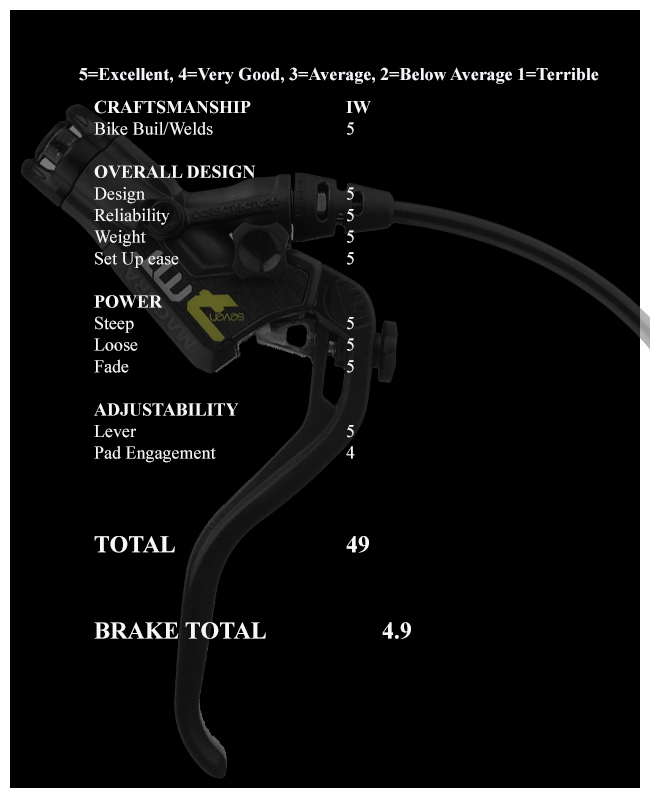
;) Trevor RolandOverall the Magura MT7 brakes impressed us a bunch. They are very light and offer an incredible amount of power that is very very useable. The tooless brake lever is the one we chose but it was also somewhat limiting. You get about 3 full rotations on the pad engagement and lever throw. I think next time the tool version is what we would go with. It isn't very often that you adjust brakes on the go anyhow. Another thing to note is that the brakes when ordered will need to have line length specified. It is very easy to cut them luckily and took about 5 minutes in total with no bleeding needed.
Trevor RolandOverall the Magura MT7 brakes impressed us a bunch. They are very light and offer an incredible amount of power that is very very useable. The tooless brake lever is the one we chose but it was also somewhat limiting. You get about 3 full rotations on the pad engagement and lever throw. I think next time the tool version is what we would go with. It isn't very often that you adjust brakes on the go anyhow. Another thing to note is that the brakes when ordered will need to have line length specified. It is very easy to cut them luckily and took about 5 minutes in total with no bleeding needed.
;) Trevor Roland
Trevor Roland
Q & A With Magura About The MT7's
1. What was Magura's primary goal in creating and designing the MT7 brake system?
Our primary goal in creating the MT7 was to address a need for the gravity crowd.
Since our own Gustav's demise several years ago, consumers have asked for a replacement so we saw a need to deliver the most durable, stable, light and powerful yet most importantly great modulating brake available. The brake lever/tire patch communication is tantamount.
2. It has been awhile since you guys offered a gravity brake. Why did it take so long?
Mountain bike hydraulic disc brake performance has progressed considerably and twin piston caliper's (w/large rotors) are very good performers however the gravity market, bikes and riding areas have also progressed so we saw the opportunity and need to reinvest in this segment.
3. Was weight or braking power of more importance with the MT7's?
Equal in our case! Usually this is not possible and you have to choose but with the new materials available (in this case Carbon Fiber) AND the ability to manufacture them, then for some manufacturers, both are possible.
In addition, we use an equation in designing our brakes that must equally consider, performance (heat stability and power), weight, ergonomics and feel.
4. Would you guys suggest riders looking for more modulation to run the standard rotor as opposed to the SL variety?
Feel does vary slightly between usages of the two model rotors but really; the non-SL rotor has more stability under heat loads and cycles. It's really for more extreme scenarios like heavier bikes and riders, more vertical terrain, longer descents and even to compensate for braking techniques like brake draggers.
5. Any tips or tricks to getting a clean bleed with the MT7 brakes?
This new model Next MT brake line has evolved in many ways and servicing was as important of a goal. The MC reservoir bladder was repositioned, the bleed port beefed up, the internal fluid routings simplified and therefore early feedback has been super positive for servicing success and ease.
Always remove the caliper while bleeding (orients the caliper properly for air evacuation) as it simplifies the process and assures success. Positioning the MC angle correctly is as important and following a 4 stroke bleed procedure which includes vacuum strokes that help assure fluid (and air) movement.
6. At some point do you think the tool less version will have more adjustment in it?
Absolutely! Due to feedback, this is our #1 task at the moment. Production changes are occurring NOW.
7. Are you guys stoked to have Intense/Palmer back on Magura?
Huge! We are honored to be involved again with Napalm and the Intense crew. Additionally, Shaun, Intense and Magura are re-investing back into our Mountain bike community with youth development, repeat Huge!
8. What do you think where the top 3 advancements in MTB technology in the last 20 years?
Materials usage, manufacturing ability, testing equipment and data. That may be 4, sorry.
9. Climbs or descents?
I'm into speed so descents are most fun but you've got to get to the top so it is most rewarding to pedal!
10. Rocks or jumps?
Both are welcome, both are needed.
11. What do you think the future holds for the industry as a whole?
The future is bright with diversity, which is the best part isn't it? We get choices and are very fortunate to have options. The quiver continues to grow, as the categories get more specific.
12. Any information you want the viewers to know about the MT7 brakes?
The MT 7 Next is the usage of exotic materials and innovative manufacturing technique combined with existing knowledge from our mountain bike and motorcycle experience. This gets lost sometimes but the ability to bring the ideas to fruition and deliver to the end consumer is sometimes the hardest and least appreciated parts of the equation.
We try real hard and never give up. This product is an example of this, a continued evolution in design and manufacturing, listening to our consumers and dealers and competing with other quality manufacturers whom are constantly trying to raise the bar!
;) Trevor Roland
Trevor Roland
The Magura MT7 brakes accomplish what they had intended. Providing a lightweight brakes with immense power, good modulation and is easily servicable by the consumer. Overall we where very happy with the brakes and would for sure reccomend them to a friend. Just keep in mind that these are their DH brakes and a 180/160mm rotor set up should be plenty. These brakes are some of the best out there and also some of the lightest. Magura hit the ball out of the park with their MT7 brakes!